Staging for the camera
Roma photography as a theatrical event
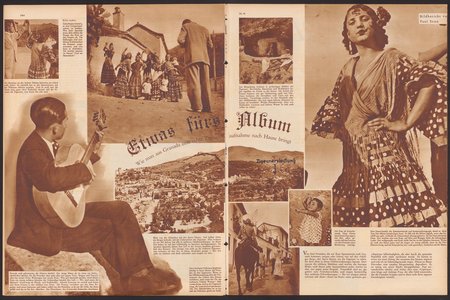
Photo reportage by Paul Senn on the Roma settlement of Sacro Monte in Granada, Spain, Zürcher Illustrierte, 16 November 1934, pp. 1464–1465
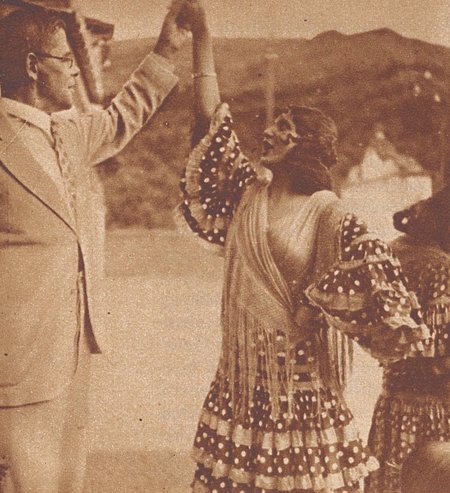
‘Beautiful señorita, raise your hand, please!’ Excerpt from the photo reportage on the Roma settlement of Sacro Monte in Granada, Spain, Zürcher Illustrierte, 16 November 1934, p. 1464
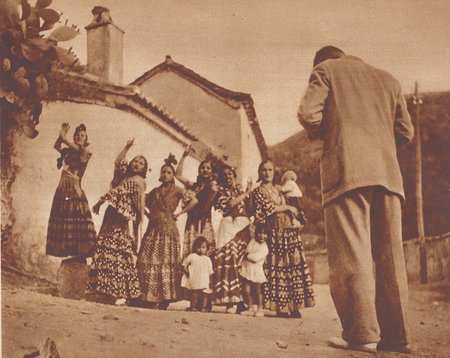
‘The positions are finally set to the photographer's satisfaction, and now he can press the shutter.’ Excerpt from the photo reportage on the Sacro Monte Roma settlement in Granada, Zürcher Illustrierte, 16 November 1934, p. 1464
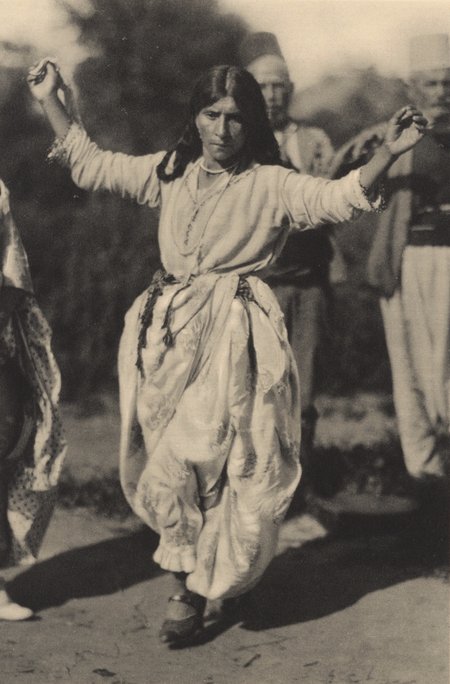
Hugo Bernatzik: Dancer in Elbasan, Albania, Atlantis, No. 5, 1932, p. 295
Although numerous photographic reports on Roma and Sinti claim to be documentary in nature, in reality they are thoroughly staged and reflect the photographers’ wishes and projections.
Contemporary newspapers and magazines repeatedly address the act of photographing representatives of Roma communities. Occasionally, journalists and photographers report in newspapers about the difficulties and obstacles they encounter when designing and implementing photo reports on Roma and Sinti. These autobiographical accounts provide a glimpse behind the scenes of photography and reporting, albeit with caution and restrictions. The following accounts of travellers, journalists and photographers on photographing Roma and Sinti are almost exclusively from non-Roma. These comments represent enormously important contextual material that can contribute significantly to a more precise understanding and interpretation of the complex network of relationships between photographers and those photographed.
Numerous photo reports on Roma and Sinti usually implicitly, and occasionally explicitly, claim to be documentary in nature.[1] On closer inspection, however, it becomes clear how fragile this documentary postulate is and how much the photographic stagings correspond to the photographers' own desires and projections. If the scenes they encounter do not correspond to the photographer's ideas, photographers may even decide not to take any pictures at all. In 1930, for example, an Austrian photographer reported candidly in an article entitled “With the Camera in the Gypsy Village” on the discrepancy between the scene he encountered and his divergent “ideal” ideas about a Burgenland[2] Roma village he wanted to photograph: “Should we photograph them?” he asked himself, and immediately gave the answer: “No, they are not picturesque enough for us.” (Illustrierte Kronenzeitung, 10 December 1930: 2)
However, the “picturesque” ingredients of a scene are often not just “found”, but far more frequently actively created and staged. Numerous reports address this theatrical construction of photographic events. The interests and perspectives of the photographers who seek and implement this “staging” play an important role. A large proportion of the photos taken in the Roma settlement of Sacro Monte in Granada, Spain, for example, follow this performative logic. The photographers visit the settlement, negotiate with representatives of the Roma community on site about the “show” they expect, and then, once they have reached an agreement (including a financial one), they receive a precisely designed musical and dance performance that corresponds to these preconceptions. These scenes are then photographed. As supposedly “authentic” images, these photographs are then fed into the media system of the illustrated press.
Swiss photojournalist Paul Senn[3] vividly describes this staged and thoroughly theatrical process in a photo reportage from 1934 in texts and images. The subtitle of his reportage is: “How to bring home a genuine gypsy photograph from Granada.” In this photo report, the journalist and photographer provides an interesting glimpse behind the scenes of the photographic stage. He shows how the images are created through precise stage directions. In the upper left image, the photographer can be seen “setting up” the dancer's pose. The accompanying caption describes how this direction is put into practice, based on the photographer's ideas and projections. The caption reads: ”The amateur at work: Beautiful señorita, raise your hand, please! That's how he saw the Spanish women on all the posters at home. And that's how the photo(graphy) must be, regardless of the fact that the Gitanos, the gypsies, are a race unto themselves.” (Zürcher Illustrierte, 16 November 1934: 1464).
In another illustration from the same report, the photographer can be seen from behind, presumably with a Rolleiflex in his hand, which he is using at chest height, photographing a group of dancers. The author also comments on this scene in the accompanying caption: “It costs ten pesetas to take a group photo like this. If you don't speak Spanish, the women will count the price on their fingers. The positions are finally taken to the satisfaction of the photographer, and now he can press the shutter. They'll be amazed at home!” (ibid.)
The photographer's “stage directions” find their counterpart in the thoroughly theatrical performances, which, as is expressly emphasised, are delivered in return for payment. The dancers of Sacro Monte do not show themselves and their everyday lives in front of the camera, but rather re-enact idealised and desired figures and poses. In other words, they are not merely passively exposed to the photographer's gaze in front of the camera, but actively participate in the scene. Occasionally, reports that mention the negotiation of dance performances for the camera also refer to “arrangements,” an agreement that involves give and take on both sides (Wiener Magazin, September 1935: 25).
Such an agreement was also reached by the travel writer and ethnologist Hugo Bernatzik who travelled through Albania in 1929, “equipped with a Klepper tent, a folding boat and Zeiss Ikon cameras” (Bernatzik 1930: 68). Among other subjects, he also intended to photograph dancing Roma women, but encountered obstacles because these dances were prohibited in the country at the time. However, he managed to get “the ban on dancing lifted for one day” and was granted special permission to take photographs (ibid.). “The gypsy women danced like mad, some even performing the old Turkish belly dance. The gypsies beat the tambourine and I took photographs.” (ibid.).[4] He noted attentively that the dancers “already wore modern high-heeled shoes (...) everywhere with their old-style dresses”.
The act of photographing describes a visual regime that is hierarchical in its basic structure, but also offers the photographed subjects a small amount of freedom. In 1935, journalist and photographer Fernand Jellinek-Mercedes also described a visit to Monte Sacro in Granada. He explains that the female dancers took the initiative in their encounter with the travellers and photographers. They “had known since early morning that a group of travellers from a foreign country was staying in Granada and invited us to their dance performances on Sacro Monte.” (Wiener Magazin, September 1935: 23). One of the women struck a dance-like, inviting pose in front of the group of visitors and “asked us to photograph [her]” (ibid.). In this case, the initiative to take pictures came not only from the photographer, but also from the “model”, who took the reins into her own hands to a certain extent.
Excerpt from:
Anton Holzer: Gazes/Countergazes. Roma and Sinti in Photography, in: Romani Studies, Vol. 36. No. 1, 2026.
The full article is available online here.
------------
[1] The documentary claim of the medium of photography is often contrasted with its staged use in practice. Elizabeth Edwards, using the example of historical colonial photography, pointed out this ‘fluctuation’ between sober documentation and staged interpretation (Edwards, Elizabeth, ed. 1992. Anthropology and photography 1860–1920. New Haven; London: Yale University Press, 8–10).
[2] Burgenland is an Austrian region on the border with Hungary.
[3] Schürpf, Markus, and Frehner, Matthias, eds. 2007. Paul Senn: Fotoreporter, Zürich: Scheidegger & Spiess.
[4] Some of Bernatziks photos taken on this occasion were published in 1932 (without naming the photographer) in the magazine Atlantis.