Returning the Gaze
Photography as a business relationship
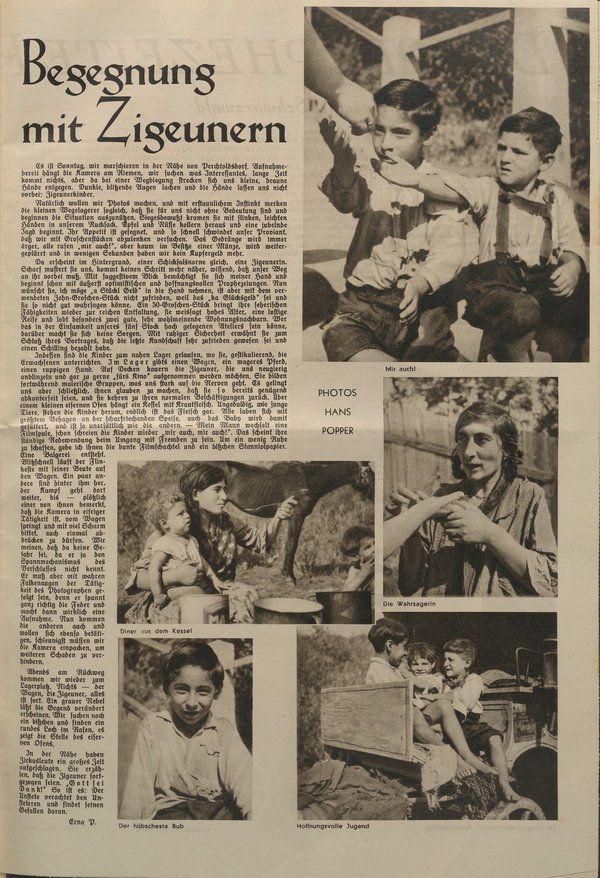
Photo reportage by Hans and Erna Popper about their encounter with a Roma group in the vicinity of Vienna, Der Sonntag, 14 October 1934, p. 34
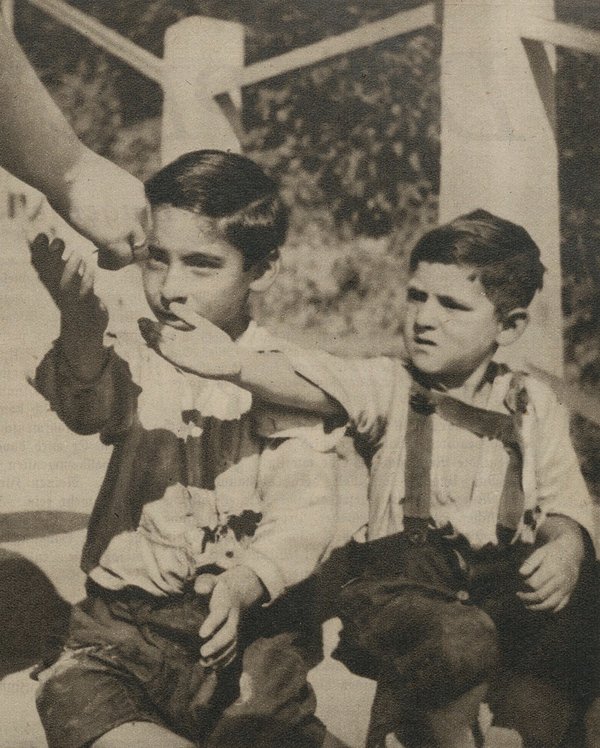
“Me too!” Excerpt from the photo reportage about an encounter with a Roma group, Der Sonntag, 14 October 1934, p. 34
Money, cigarettes or other gifts – in exchange for expected images. Photographs of Roma and Sinti were often taken in the context of (mostly unequal) exchanges. A case study shows how these exchanges took place.
Numerous other reports have been preserved in contemporary journalism that describe photography in exchange for money, cigarettes or other gifts. Payment establishes an economic relationship between the photographer, who wants to take “good” pictures, and the subjects, who can provide or “pose” for these scenes. However, it also shows that the subjects had a certain amount of bargaining power, because if they did not agree with this exchange, they could refuse to cooperate in the photographic act.
Erna and Hans Popper, a Viennese couple who often travelled together on their photographic ventures, give a particularly impressive account of such a business encounter. Hans Popper took the photos, while his wife often wrote the accompanying texts for the newspaper. In a photo reportage from 1934, the two give a detailed account in text and pictures of an “encounter with gypsies” in the vicinity of Vienna (Der Sonntag, 14 October 1934: 34). As so often, the members of the Roma group remain nameless in their report. The focus of the account is a kind of commercial exchange in which the photographing or posing in front of the camera is “rewarded” with small coins or pieces of food.
“It is Sunday, we are marching near Perchtoldsdorf. The camera hangs ready to shoot on its strap, we are looking for something interesting, but for a long time nothing comes along, until, at a bend in the road, small brown hands reach out to us. Dark, sparkling eyes laugh and the hands won't let us pass: gypsy children. Of course we want to take photos, and with astonishing instinct, the little highwaymen immediately realise that they are not insignificant to us and begin to take advantage of the situation. Confident of victory, they rummage through our rucksack with nimble, light hands. Apples and nuts roll out and a jubilant hunt begins. Their appetite is blessed, and our provisions disappear so quickly that we try to distract them with pennies. The crowd becomes more and more aggressive, everyone shouting ‘me too!’, but as soon as they have a coin in their possession, the clamour continues and in a few seconds we have no more copper coins left.” (ibid).
The great power imbalance of this encounter is completely obscured in this description. In its place is an amused portrayal of droll children fighting over the visitors' souvenirs and, as it were, incidentally coming into the camera's view. This example also illustrates very clearly how complex the process of photography is, involving a give and take. In this case is portrayed as a kind of power struggle between the photographer and his wife, who dominate the hierarchical visual structure, and the weaker subjects who were portrayed with the camera, especially the children. At the heart of this power struggle is the negotiation of the “price” for taking the photograph. The Roma children search visitors' rucksacks for useful items or are enticed by coins thrown down to them from above. If they agree to the “deal”, they make their bodies available as photographic objects in return.
A little later, the scuffle turns serious, once again involving an exchange, and once again involving money.
“Then, like a Fates, a gypsy woman appears in the background. She eyes us sharply, not coming any closer, knowing that we must pass her. With a suggestive look, she takes hold of my hand and begins to make extremely optimistic and hopeful prophecies. Now she wants me to take ‘bit of money’ in my hand, but she is not satisfied with the ten-pence piece I use because it is ‘lucky money’ and she cannot tell my fortune properly with it. A 50-pence coin brings her clairvoyant abilities back to full fruition; she predicts old age, a fun trip and praises two good, very well-meaning neighbours in particular. She does not worry about who these might be in the solitude of our fifth-floor studio. With calm confidence, she mentions at the end of her lecture that the last customer was very satisfied and paid a shilling.” (ibid.).
The photographer and the journalist also use this opportunity to turn the “business” into a visual exchange. A photo in the report shows the “fortune teller” at work. In her hands lies the visitor's hand. The “encounter” between the observers and the observed has left visible traces in this report. The hierarchical nature of this encounter between the photographers and the photographed is evident in the fact that the “strangers” portrayed can be seen with their entire bodies, while the visitors only extend selected parts of their bodies into the picture, such as the arm that the “fortune teller” is holding in her hand. In a second shot, a hand appears again, approaching the outstretched hands of the two boys from above to press a coin into their hands in return for the photos.
(…)
One of the Roma children, who had previously been caught in the view of the camera belonging to the outsiders, suddenly and swiftly seizes the photographic apparatus and reverses the perspective. It sets about looking back.
“My husband,” Erna Popper recalls this scene, “changes a film reel, and the children immediately shout ‘me too, me too!’. That seems to be their constant refrain when dealing with strangers. To create a little peace and quiet, I give them the colourful film box and some tin foil. A scuffle ensues. In a flash, the quickest one runs to the car with his booty. A few others are after him, and the fight continues there until – suddenly one of them notices that the camera is in eager action, jumps off the car and asks with great charm to be allowed to press the shutter button once. We think there is no danger, as he does not know how to operate the shutter release mechanism. But he must have been watching the photographer's actions with eagle eyes, because he winds the spring correctly and then actually takes a picture. Now the others come too and want to do the same, so we have to pack up the camera quickly to prevent further damage.” (Der Sonntag, 14 October 1934: 34).
This little episode, in which a child who was previously in the photographer's view suddenly seizes the camera and takes pictures on his own authority, is newsworthy from the point of view of the photographer and the journalist because here the long-established power structure, the carefully rehearsed hierarchy of seeing, is momentarily disrupted. The child takes control of the camera and prepares to return the gaze. The owners of the camera quickly put an end to this “haunting” in order, as they say, “to prevent further damage.” The established hierarchy of gazes is thus restored. It remains unclear whether the photograph taken by the child was later developed by photographer Hans Popper. In any case, the photograph is not part of the printed photo reportage. The returned gaze remains empty.
Excerpt from:
Anton Holzer: Gazes/Countergazes. Roma and Sinti in Photography, in: Romani Studies, Vol. 36. No. 1, 2026.
The full article is available online here.