Resistance and Fear
Aggressive voyeurism and forms of opposition
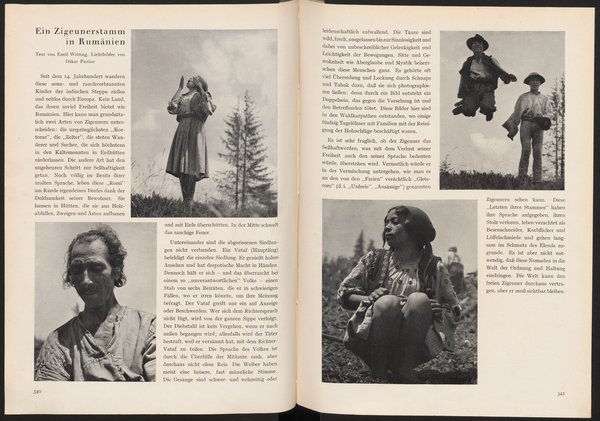
Emil Witting, Oskar Pastior: Photo report about the everyday life of Roma groups in northern Romania, Atlantis, 6 June 1935, pp. 340–341
Photographers who took pictures of Romani people often engaged in a form of aggressive voyeurism. However, they were not always successful; their intrusiveness met with resistance and fear from those being photographed. It was often young women who tried to escape this photographic intrusion.
According to reports, the presence of the camera not only aroused fascination and curiosity on the part of those being photographed, but also led to completely different reactions, such as fear or resistance, and occasionally even caused people to flee. According to one photographer, a “cute little girl” in a Burgenland Roma settlement refused to be photographed. But the visitor did not give up. “She has to stand in front of the camera, even if she resists. One shilling for a photograph – that's the fee the gypsies charge.” (Illustrierte Kronenzeitung, 10 December 1930: 2).
This insistence was not always successful. Occasionally, the subjects of the camera's gaze slipped away – and no photo was taken. “I took some very interesting photographs in their neighbourhood,” reports Czech journalist and traveller S. Vohanka, who photographed a Bulgarian Roma settlement in 1928, “but I couldn't persuade a girl who was weaving mats to let me take her picture. I had to ask her father for permission first. I came back the next day, but it was too late: the girl had been kidnapped in the meantime.” (Pestrý týden, 4 August 1928: 14).
Austrian photojournalist Steffi Schaffelhofer also reports in detail on the fears and resistance she encountered in the late 1930s while taking photographs in a Roma settlement in the Ukrainian Carpathians. The women, she writes in her report, “looked at me suspiciously, even hostilely, and took their children in their arms as if to protect them from me. Only when my guide interpreted that I had absolutely peaceful intentions and was even willing to prove this with hard cash did they become a little more trusting, but they remained very reserved. The men looked somewhat embarrassed and apparently did not quite know what to make of my visit. My guide promised the children a ‘shower of coins’ if they let me take their picture. This concession to the little group was somewhat premature. I was immediately surrounded by the children, who, depending on their temperament, either pressed themselves close to me or lurked around me. Most of the little ones were barely older than two or three years old. When one of the children saw the lens of my camera pointed at him and suddenly heard the shutter click, he grimaced fearfully and made a tearful face. Another little one was bolder. With shaggy hair, he stood in front of me and waited. He had tied a green cloth around his small body and struck a pose like an ancient Roman. He looked at me with dark eyes and didn't flinch in the slightest when he was photographed.” (Vorarlberger Wacht, 21 October 1937: 4).
The photographers – predominantly men – showed a particular interest in photographing young girls and women, often in situations involving dancing. The gaze of the male observer/photographer, who scrutinizes the dancing body of the young woman with his eyes, his camera and often also his appraising descriptions, is a recurring pattern in the history of photography of Roma and Sinti. Indeed, one could even say that this motif – simply because of its frequency in many countries to this day – belongs to the core repertoire of the sexist, misogynistic and sexualised gaze of male photographers.
The female models and dancers who caught the photographers' attention repeatedly tried to escape this voyeuristic intrusiveness. In a photo reportage on “Turkish” Roma groups in the Romanian Dobruja region, journalist T. Luca describes the lengthy haggling and bartering that took place in order to obtain permission to photograph the dancing woman.
“We wanted to see something specifically Tatar. We chose the most beautiful of the girls and asked her to dance for us. Fehamet is plump, with oval cheeks, pepper-black eyes and a row of sparkling white teeth. On her head she wears a yellow turban, the distinguishing mark of the village's femme fatale, and a wreath of flowers above it. ‘Dance for us, Fehamet, we'll give you ten lei.’ ‘That's not possible, it's not allowed when gentlemen are present.’ ‘Come on, Fehamet, we'll give you 20 lei. ... How much paprika can you buy for 20 lei?’ ... ‘Come on, but give me the money first.’ ‘We'll give you the money.’ […] Apart from the mattresses, there is nothing in the room except for a pile of carpets in one corner that reaches up to the ceiling. Fehamet pulls the door handle, locks herself in the room with us and ... reaches out her hand to us again with a devilish laugh: ‘Now give me the money.’ Although there are about ten of us, we are slowly beginning to dislike the joke. ‘Dance first or open the door,’ says a slightly hoarse male voice. Fehamet laughs. Slowly, she begins to make a few belly movements and snap her fingers to imitate castanets” (Ilustratiunea Română, 14 September 1932: 14).
Here, too, it is clear that the images were often purchased and the views enforced against resistance. In this case, resistance to the display of the female body is broken by long, tough negotiations (not with the woman, but between the male visitors and the woman's “representative”, who is also male), but ultimately, as in other situations, by payment. “We appease Ahmet with a pack of ‘National’ cigarettes and befriend him so well that he even lets us take his picture – even though the Koran does not allow it – for two lei, of course.” (ibid.).
Similar resistance to photography is also described by the journalist and writer Emil Witting from Transylvania, who documented the everyday life and customs of Roma communities in the Romanian Carpathian Mountains in the early 1930s together with the photographer Oskar Pastior. The two men, who were outsiders, were particularly interested in the women's songs and dances. “The songs are heavy and melancholic, or passionately stirring. The dances are wild, cheeky, exuberant to the point of absurdity, and yet characterised by indescribable agility and lightness of movement. Customs and traditions, superstition and music completely dominate these people.” (Atlantis, 6 June 1935: 341). When it finally came to taking photographs, the visitors encountered resistance. In this case, too, material “rewards” were used to break down this resistance. “It often took a lot of persuasion and enticement with schnapps and tobacco to get them to allow themselves to be photographed: for a picture creates a double that is against providence and kills the person concerned.” (ibid.).
One of the photos accompanying the magazine article shows a young woman crouching on the ground in a voyeuristic and intrusive manner. Her skirt is pushed up, her legs are exposed, and her crotch is hinted at. The young woman does not turn her head towards the camera, but has turned it to the side. This reluctance to be photographed also appears in numerous other reports. From the perspective of journalists and photographers who present themselves as “urban and enlightened,” this reluctance is often portrayed as “superstition” or a remnant of ancient magical thinking, which is found not only in remote regions of Europe but also in urban areas. The Hungarian journalist Ferenc Sima, for example, describes a visit to a Roma community in Budapest in a report. He reports that, unlike the young members, the older members were also afraid of being photographed. “These old gypsy women are strange. They are afraid of the camera. An old gypsy superstition says that photography takes a piece of your soul. And the old people here are very superstitious. The young people are no longer.” (Szinházi Magazin, 5 March 1939: 31).
The desire not to be photographed is repeatedly noted, but ultimately not respected. Photographs are often taken against the will of the subjects, with a great deal of persuasion, but also in exchange for money, provisions, tobacco, cigarettes and, as in the example mentioned, alcohol. Even though the subjects' objections to having their picture taken often had no effect in practice and the photos were taken anyway, these examples ultimately also show acts of resistance. The numerous similar situations that have been reported also show that these objections were not just occasional, but occurred regularly and in very different situations and countries. As described, this resistance may sometimes have been motivated by a fear of being photographed. However, it can undoubtedly also be interpreted as an implicit or explicit objection to the photographic objectification and voyeuristic exposure of the body, which was often female.
Excerpt from:
Anton Holzer: Gazes/Countergazes. Roma and Sinti in Photography, in: Romani Studies, Vol. 36. No. 1, 2026.
The full article is available online here.