Anticipated Poses
“Collaboration” of the Romani subjects in Photography
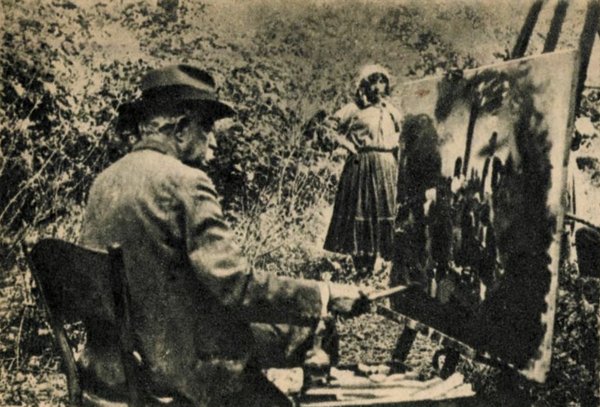
The Hungarian painter Béla Iványi-Grünwald and his model, Tolnai Világlapja, 15 September 1937, p. 32
The history of Roma photography is characterised by strict hierarchies. Nevertheless, those portrayed were not entirely powerless. There are numerous examples of how they actively participated in the photographic process – and developed their own agency.
Eve Rosenhaft emphasises that the act of photography always represents a complex network of relationships between the viewer (the photographer, but also later viewers of the images) and the viewed (the subjects).[1] This also applies to hierarchical viewing relationships characterised by unequal power relations. Even in this setting, the subjects have certain opportunities to actively participate in the photographic process.
In her book The Civil Contract of Photography, Ariella Azoulay emphasises that the subjects never completely disappear into the identifying and hierarchising gaze of the camera and the viewer. Even in subaltern photographic roles, they can escape the powerful and dominant gaze to a certain extent.[2] The author, who speaks in this context of “evasive presences”, concludes that a critical reading of photography therefore has the potential to question the constraints of predefined patterns of gaze and to open up alternative interpretations for some images and their social use (ibid).
But it is not only the products of the photographic act, the resulting images, that can open up new, countervailing interpretations when viewed from a critical perspective. The act of photographing itself is also usually more complex and contradictory than is often assumed. As we have seen, there are already diverse forms of “collaboration” by the subjects of the portrait in the act of representation within the photographic process itself. As early as the late 19th century and up until the interwar period, it was common for painters to recruit members of the Roma communities as models for their “Gypsy motifs”. A number of these artists also took photographs themselves and used these photographic scenes as templates for their later artistic work.[3] One of these artists was the Hungarian painter Béla Iványi-Grünwald, who drew and painted his “Gypsy motifs” during the interwar period on a farm in the small town of Balatonlelle on Lake Balaton and later also on Madách Street in Budapest. He often worked with the same models for years. “I enjoy working with them,” he said in an interview in 1937, “because they are very picturesque, move beautifully and are very intelligent. Foreigners today are very interested in the Hungarian landscape and like to buy paintings with folk motifs. But apart from the financial aspect, as an artist I enjoy working with this colourful subject matter.” (Tolnai Világlapja, 15 September 1937: 32).
Iványi-Grünwald's models did not appear on stage unprepared; they knew exactly which clothes (provided by the painter for the sessions) to wear and which poses and postures to adopt. “It is immediately apparent,” according to the mentioned newspaper report about one of these “sessions”, “that they have been serving him [the painter] for a long time, because they know all his habits. They quickly set up the easel, place the wobbly chair next to it with the paint box on it, slide a blanket under his feet so that he doesn't get cold in the wet grass, then line up and wait for their turn. The composition of the picture is finished, it has already been sketched, and now the artist begins to work on the details. He calls only one figure to him, the others huddle silently around the fire. The young Gypsy mother is the first to stand in front of the easel. The woman, dressed in a yellow skirt and a red turban, has taken the smallest girl in her arms and looks down at her lovingly. The artist gives her no instructions; she instinctively finds the position, her head bent over the little one wrapped in colourful rags, as no actress could have done better.” (ibid.).
This example shows how complex the forms of collaboration between painters and models were in the production of (marketable) Roma images. Although the models were in a subordinate hierarchical position and had to portray highly stereotyped roles, they were still able to weigh up the conditions, costs and benefits of their collaboration. Among other things, they had to decide which individual gains (including a small income) outweighed the collective losses, such as the externally imposed representation of their bodies for a voyeuristic audience. In many respects, they were actively involved in a commercial image production at the lowest level.
Similar forms of anticipatory “collaboration” can be found not only in the production of paintings, but also in photography in the narrower sense. Time and again, photographers report that the “models” they had in mind for a photo took poses of their own accord and played the desired roles. When the French-speaking Swiss couple Mr and Mrs Mercier, both passionate amateur photographers from Switzerland, visited Monte Sacro in Granada in 1937 and wanted to photograph the dancers, they positioned themselves without any direction. The Swiss guests noted: “Since we wanted to see a dance, the two Gypsy women struck suggestive poses with confidence, suppleness and irresistible grace.” (En Famille. Revue illustrée pour la famille, 9 October 1937: 1296).
Excerpt from:
Anton Holzer: Gazes/Countergazes. Roma and Sinti in Photography, in: Romani Studies, Vol. 36. No. 1, 2026.
The full article is available online here.
------------
[1] Rosenhaft, Eve. 2004. A photographer and his “victims” 1934–1964: Reconstructing a shared experience of the Romani Holocaust. In: Saul, Nicolas, and Tebbutt, Susan, eds. The role of the Romanies. Images and counter-images of “Gypsies”/Romanies in European cultures. Liverpool: Liverpool University Press. 178–207, here 183.
[2] Azoulay, Ariella. 2008. The civil contract of photography. Princeton: Princeton University Press, 375.
[3] In her stimulating essay, Éva Kovács points out that the so-called “Pußtamaler”, i.e. those painters, who became famous for their Hungarian and Roma motifs, often used the medium of photography. Conversely, their painted motifs later also appeared as templates for photographic stagings. Kovács, Éva. 2021. Black bodies – white bodies – “Gypsy”-images in Central Europe 1880–1920. Critical Romani Studies 3 (2): 72–93. DOI: https://doi.org/10.29098/crs.v3i2.75